 Add to Chrome
 Add to Firefox
 Add to Edge
Beyond Independent Manipulation: Individual Fairness-aware Strategic Classification with Peer Imitation
May 30, 2026
Strategic classification (SC) investigates scenarios where agents manipulate their features to obtain favorable decisions from predictive models. Existing fairness-aware SC approaches primarily focus on group fairness and typically assume that agents respond independently. However, when individual fairness is required, ensuring similar individuals receive similar outcomes, agents' manipulation becomes interdependent: an agent's preferred manipulation depends on the neighborhoods' outcomes. This induces a mismatch between classical SC formulations and fairness-aware decision settings, where independent models no longer accurately characterize strategic manipulations. To address this issue, we introduce individual fairness-aware strategic classification (IFSC), a framework that models peer-driven manipulation arising from individual fairness, where agents imitate nearby positively decided peers to obtain favorable outcomes. IFSC characterizes strategic manipulation as similarity-based imitation toward visible accepted peers and learns classifiers under the resulting post-manipulation distributions. To account for uncertainty in peer observability, IFSC employs a robust learning process that introduces stochastic perturbations during manipulation simulation. Experiments on synthetic and real-world datasets demonstrate that IFSC improves individual-fairness consistency and mitigates imitation-induced distortions.

Beyond Rational Illusion: Behaviorally Realistic Strategic Classification
May 19, 2026Strategic classification(SC) studies the interaction between decision models and agents who strategically manipulate their features for favorable outcomes. Existing SC frameworks typically rely on the idealized assumption that agents are strictly rational. However, evidence from behavioral economics and psychology consistently shows that real-world decision-making is often shaped by cognitive biases, deviating from pure rationality. To formalize this limitation, we identify and define a new problem setting, termed the behaviorally realistic strategic classification problem, where agents' strategic manipulations deviate from full rationality due to psychological biases. Motivated by the identified limitation, we propose the Prospect-Guided Strategic Framework (Pro-SF) to address the problem, a principled framework grounded in prospect theory to model and learn under behaviorally realistic strategic responses. Specifically, to capture behaviorally realistic strategic manipulations, our framework reformulates the Stackelberg-style interaction between agents and the decision-maker by incorporating three key mechanisms inspired by prospect theory, including the asymmetry between benefits and costs, different subjective reference points, and non-rational probability distortion. Experiments on synthetic and real-world datasets establish Pro-SF as a behaviorally grounded approach to strategic classification, bridging machine learning and behavioral economics for more reliable deployment in the real world.
When Tabular Foundation Models Meet Strategic Tabular Data: A Prior Alignment Approach
May 19, 2026Tabular foundation models based on pretrained prior-data fitted networks~(PFNs) have shown strong generalization on diverse tabular tasks, but they are typically designed for \emph{non-strategic} settings where data distributions are independent of deployed classifiers. In many real-world decision scenarios, however, individuals may strategically modify their features after deployment to obtain favorable outcomes, inducing a post-deployment distribution shift. This paper studies whether PFN-style tabular foundation models can generalize to such \emph{strategic} tabular data. We show that strategic manipulation creates a mismatch between the non-strategic prior learned during pretraining and the post-manipulation strategic prior, which leads to systematic prediction bias. To address this issue, we propose \textbf{Strategic Prior-data Fitted Network}~\textit{(SPN)}, an inference-time strategy-aware framework that adapts tabular foundation models to strategic environments without retraining. SPN constructs strategic in-context examples to approximate post-manipulation inputs and aligns PFN predictions with the induced strategic distribution. Experiments on real-world and synthetic tabular datasets show that SPN consistently improves robustness and predictive performance under strategic manipulation compared with both tabular foundation models and classical tabular methods.
Breaking the Gradient Barrier: Unveiling Large Language Models for Strategic Classification
Nov 10, 2025Strategic classification~(SC) explores how individuals or entities modify their features strategically to achieve favorable classification outcomes. However, existing SC methods, which are largely based on linear models or shallow neural networks, face significant limitations in terms of scalability and capacity when applied to real-world datasets with significantly increasing scale, especially in financial services and the internet sector. In this paper, we investigate how to leverage large language models to design a more scalable and efficient SC framework, especially in the case of growing individuals engaged with decision-making processes. Specifically, we introduce GLIM, a gradient-free SC method grounded in in-context learning. During the feed-forward process of self-attention, GLIM implicitly simulates the typical bi-level optimization process of SC, including both the feature manipulation and decision rule optimization. Without fine-tuning the LLMs, our proposed GLIM enjoys the advantage of cost-effective adaptation in dynamic strategic environments. Theoretically, we prove GLIM can support pre-trained LLMs to adapt to a broad range of strategic manipulations. We validate our approach through experiments with a collection of pre-trained LLMs on real-world and synthetic datasets in financial and internet domains, demonstrating that our GLIM exhibits both robustness and efficiency, and offering an effective solution for large-scale SC tasks.
Beluga Whale Detection from Satellite Imagery with Point Labels
May 17, 2025
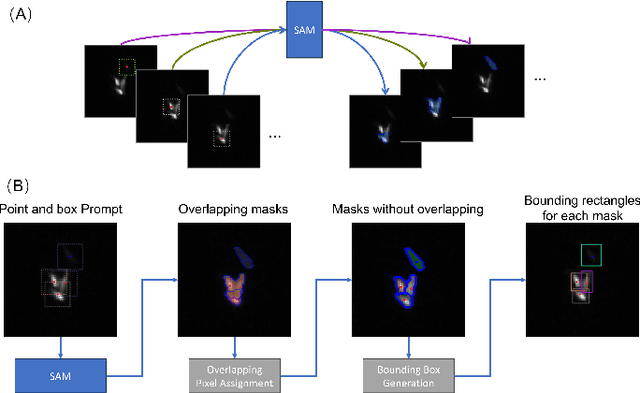
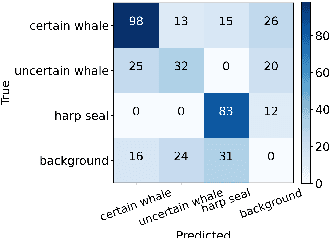
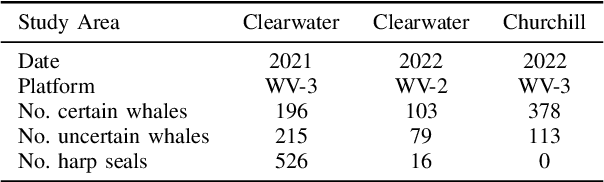
Very high-resolution (VHR) satellite imagery has emerged as a powerful tool for monitoring marine animals on a large scale. However, existing deep learning-based whale detection methods usually require manually created, high-quality bounding box annotations, which are labor-intensive to produce. Moreover, existing studies often exclude ``uncertain whales'', individuals that have ambiguous appearances in satellite imagery, limiting the applicability of these models in real-world scenarios. To address these limitations, this study introduces an automated pipeline for detecting beluga whales and harp seals in VHR satellite imagery. The pipeline leverages point annotations and the Segment Anything Model (SAM) to generate precise bounding box annotations, which are used to train YOLOv8 for multiclass detection of certain whales, uncertain whales, and harp seals. Experimental results demonstrated that SAM-generated annotations significantly improved detection performance, achieving higher $\text{F}_\text{1}$-scores compared to traditional buffer-based annotations. YOLOv8 trained on SAM-labeled boxes achieved an overall $\text{F}_\text{1}$-score of 72.2% for whales overall and 70.3% for harp seals, with superior performance in dense scenes. The proposed approach not only reduces the manual effort required for annotation but also enhances the detection of uncertain whales, offering a more comprehensive solution for marine animal monitoring. This method holds great potential for extending to other species, habitats, and remote sensing platforms, as well as for estimating whale biometrics, thereby advancing ecological monitoring and conservation efforts. The codes for our label and detection pipeline are publicly available at http://github.com/voyagerxvoyagerx/beluga-seeker .